
Trace Owen County Former Owners by Era
The deepest ownership trail in Owen County still lives in the recorded deed books and their indexes. eCCLIX is the current electronic doorway. The Clerk posts no first year for online coverage. Firm benchmarks come from the library catalog instead. Its deed books begin with county formation, and separate grantor and grantee index runs accompany them, so pick the source whose dates actually reach the transfer under study.
| Source | Years It Covers | Where Held | What It Shows |
|---|---|---|---|
| eCCLIX deed index | Online start unpublished | Owen County Clerk | Indexed parties, instrument and recording references |
| Deed books | 1819-2002 | Owen County Public Library microfilm and cataloged books | Conveyance text, parties and land descriptions |
| Grantor/grantee indexes | Through 1961 | Library and FamilySearch catalog routes | Name-to-book and page pointers |
| Tax assessment rolls | Selected historic years | Library microfilm | An owner clue when a deed reference is missing |
For a recent Owen County transfer, open the Owen County Clerk records page. Ask at the counter if the online trail stops. Request the cited book and page. For older gaps, review the library's exact microfilm list before visiting, since it names which runs survive on film.
Start Owen Previous Owners With the Vesting Deed
The vesting deed anchors the first backward step. Pull the present grantee, recording date, deed type, and book and page or instrument number. Note the consideration and the full legal description. Any clause citing a prior conveyance can lead straight to the next deed.
Skip the temptation to substitute a PVA sale entry. Owen qPublic states that sale dates and prices are not verified, while ownership and legal descriptions are believed accurate. Use the assessment card only to identify the parcel. Then rely on the recorded land description to keep every transfer tied to the same tract.
Separate Owen Online Results From Book Depth
eCCLIX sets clear limits. Qualifying private Owen residents get free, noncommercial, Owen-only searching up to five searches per day. Commercial use takes a paid subscription. The official page publishes no earliest online year. An empty result therefore proves nothing about older deeds.
The historical record is narrower but solid. Cataloged Owen deed books run from 1819 through 2002, and grantor and grantee indexes extend through 1961. Search eCCLIX where it reaches, ask the Clerk to check office access, and carry the chain into the library, KDLA, or cataloged film when the digital trail ends.
Note: Online coverage and the surviving record are different facts, so log the last successful year before switching repositories.
Open Owen Former-Owner Record Routes
The official Owen County Clerk records page gathers the deed categories, eCCLIX access, forms, fees, and an alert service. Each piece matters in a backward search.
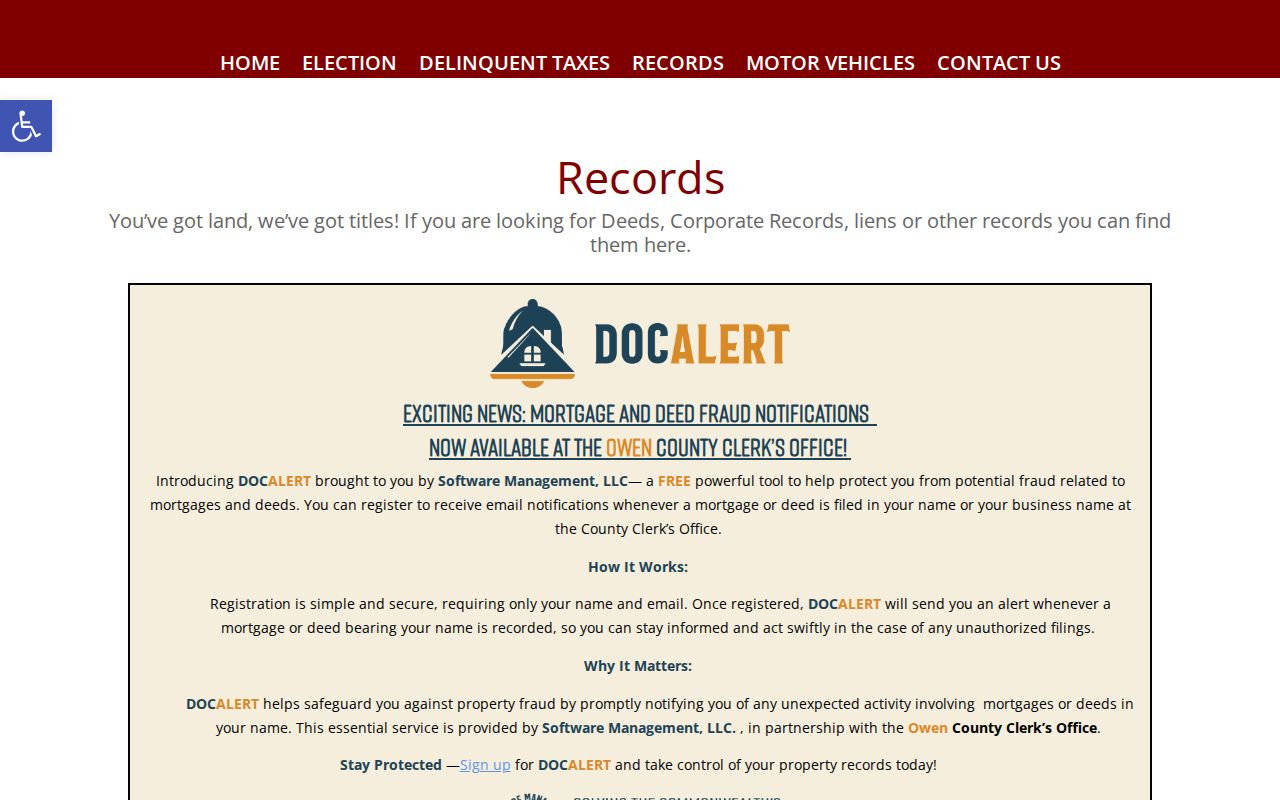
The page is a gateway, not a substitute. Use it to enter the official record route. Then preserve the parties, dates, legal description, and book-page or instrument reference from each deed found.
Recover Owen Past Owners Hidden by Index Labels
Plain seller and buyer entries miss whole transfer patterns. The KDLA deed research guide advises checking both grantor and grantee indexes. Watch for heir, commissioner, and sheriff designations. They mark a death, partition, foreclosure, or court-ordered sale.
For an estate, search the decedent, heirs, executor, administrator, and any affidavit of descent. For entities, keep prior names and punctuation variants. A commissioner or sheriff may be the indexed grantor even though the family or debtor name first led you to the case.
Reconstruct Owen County's Deed Chain Backward
Build a dated worksheet, not a loose name list. Each row connects one deed's grantee to that same party as grantor in an earlier acquisition. Only the repeated land description, acreage, plat, or prior-deed citation keeps the work on the correct parcel. That evidence makes the chain.
- Find the current vesting deed with the present owner indexed as grantee.
- Copy the grantor, deed date, recording date, deed type, reference, and full land description.
- Search that grantor as a grantee in an earlier period and compare the tract.
- Repeat, logging splits, combinations, easements, and parent-tract references separately.
- At the online edge, continue through the physical index and cited deed book.
- Grantor / grantee
- The conveying party and receiving party named in an instrument.
- Chain of title
- The linked sequence of recorded transfers affecting the same land.
- Reverse index
- An index organized from the receiving party back toward the conveying party.
- Warranty / quitclaim deed
- Different conveyance forms; neither label alone proves a clean chain.
Follow Owen Parent Tracts and Recorded Plats
A chain can appear to break. The parcel was once part of a larger tract. Town lots point to subdivision names plus lot, block, phase, and plat cabinet or page. Rural deeds read differently. They preserve roads, creeks, bearings, monuments, and adjoining owners.
Copy those calls exactly, then search the parent deed named in the description and note the later division or combination that produced the current parcel. The PVA parcel number is a tax-map key that can change; the deed and recorded plat supply the historical bridge.
Date Owen Former Owners Through Local Notices
Newspaper notices can narrow a broad deed search. The News-Herald archive is the richest local source. The library documents its microfilm for 1905, 1907-1930, 1932-1989, and part of 1991-2006. Estate, commissioner, sheriff, and probate notices yield dates, spellings, case clues, and community names. A notice is not the conveyance. Use it to fix the window. Then locate the deed, court order, or estate instrument, and lean on the library's combined deed, tax, court, mortgage, will, and newspaper runs as a crosswalk when one series stalls.
Translate Owen's Older Property Descriptions
Older deeds rarely carry a modern street number. They describe land by landmarks instead. Owenton's early civic grid used North Adams. That street is now Main. The grid also included East and West Seminary and the courthouse square. Monterey appears as Williamsburg in some records. River property near Gratz and Monterey may instead be tied to a landing. It may reference a creek, a road, or an adjoining owner.
Log the historic term you searched. Then verify it against the legal description or the plat. A Sparta postal address can sit in either Owen or Gallatin County. So confirm the county before you search. Postal wording alone proves nothing about jurisdiction.
Note: Place names are useful search clues. Only the recorded land description can carry the chain from one owner to the next.
Measure Owen County Ownership Record Depth
Owen County dates to 1819. The deed books begin that same year. No courthouse fire, flood, or catastrophic land-record loss appears in any official account. Treat a gap as an indexing, name, description, repository, or parcel-change problem first. Blaming a disaster is rarely the answer.
Deeper work may require the Clerk's books, the Owen County Public Library, or FamilySearch catalog entries. The Kentucky Department for Libraries and Archives guides can also help. Tax assessments can point to a likely former owner. An early deed may cite no prior one. A patent or original grant sits outside the ordinary county deed sequence. Check its own repository.
Historical record limit. Owen's online cutoff is unpublished. Do not describe deeds from 1819 as online, and never treat a reconstructed list as a title opinion.
Former-owner research supports house history, estate work, boundary questions, and purchase diligence. Use the names and addresses you find only for that lawful purpose. The trail must never harass a living person.
End the worksheet at the earliest supported link. A plausible surname is not enough. Record which books, indexes, tax rolls, and notices were checked, and which years remain unresolved, so the history stays distinct from a professional title examination.